AI
Meets Ham Radio

 Many of my ham radio projects are happy accidents in the sense
that they are not part of any sort of planned program.
Some even resemble QRM (radio code for ‘interference’) in the sense
that while I’m
attempting to focus on one specific project, a seemingly unrelated
thought will intrude.
Many of my ham radio projects are happy accidents in the sense
that they are not part of any sort of planned program.
Some even resemble QRM (radio code for ‘interference’) in the sense
that while I’m
attempting to focus on one specific project, a seemingly unrelated
thought will intrude.
I had been reading the Irish Radio Transmitters
Society (IRTS) Amateur Radio Station Licence Study Guide. I
recommend it by the way. It contains all sorts of interesting
information. For example, electrical grounding is done
differently in Ireland than here in the United States. But that is an
aside. While reading a few paragraphs on the subject of impedance I was
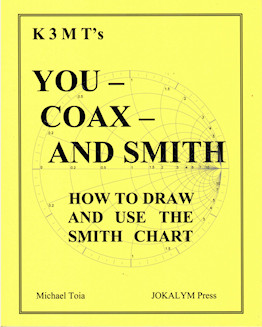
reminded of an exercise in Michael Toia’s booklet, You
Coax and Smith, which I had read a few years previously.
As it happened I was also experimenting at the time
with several so-called Artificial Intelligence (AI) applications known
as
‘Large Language Models’ (LLMs). A friend had explained that
certain LLMs could be installed as computer applications, and would run
off-line,
i.e., without connecting to the Internet. (The
example AI illustrated at the top of this page is not one of those.)
Since receiving this suggestion I
had installed several off-line AI models, and probed them with various
made-up
(artificial) problems. The least interesting of these were questions of
fact. The AI under test sometimes answered correctly and other times
bizarrely, though with equal confidence. This latter
phenomenon has a name in AI. It is called, ‘hallucinating.’
The coincidence of reading about complex impedance
and recalling Michael Toia’s exercise suggested the idea of probing AI
with one or two problems of physical measurement. There can be no
argument about
measurement. The correct answer is whatever the instrument says,
provided that the instrument and test setup have been accurately and
fairly described. My plan was to carry out the physical measurements,
not simply to calculate alongside AI and compare results.
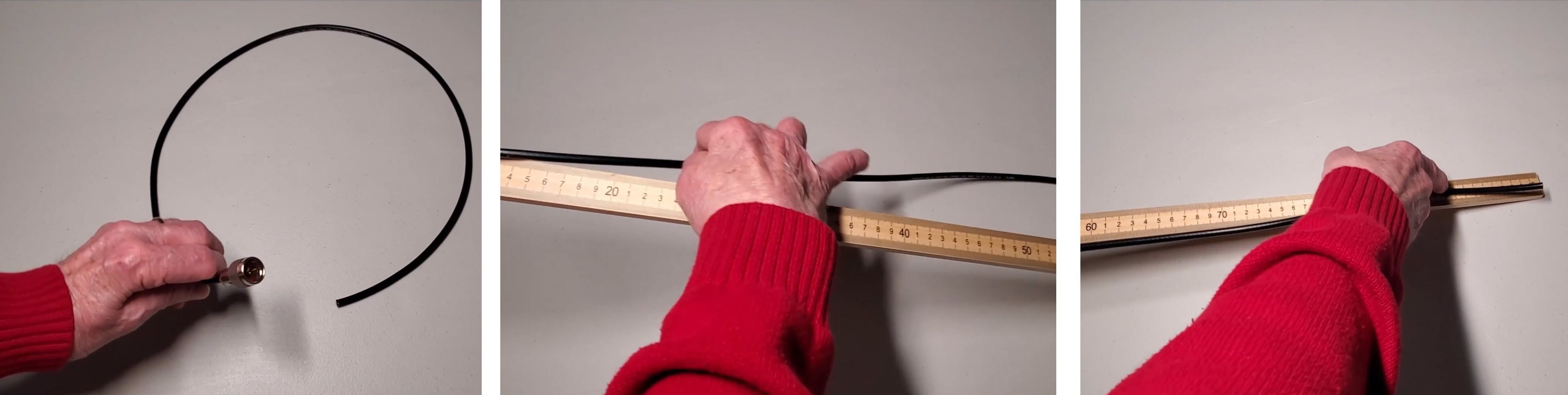
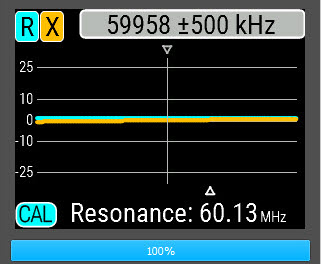
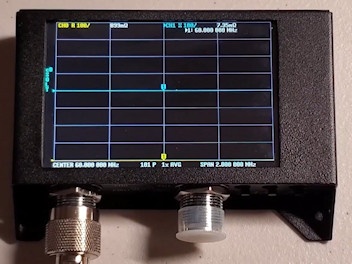 It would be less than
100% honest to refer to the transmission line impedance question
reproduced at the top of this page as a
‘physical measurement’ exercise if no actual
measurement were performed. However, complex impedance was in fact
measured under the specified parameters, using a Rig
Expert AA-230 antenna analyzer and independently with a NanoVNA. Both
instruments have female N-connectors. That is why the piece of coax has
a male N connector affixed to one end in the illustration above. The
other end was cut with my pocket knife and rubbed free of small hairs,
etc.
It would be less than
100% honest to refer to the transmission line impedance question
reproduced at the top of this page as a
‘physical measurement’ exercise if no actual
measurement were performed. However, complex impedance was in fact
measured under the specified parameters, using a Rig
Expert AA-230 antenna analyzer and independently with a NanoVNA. Both
instruments have female N-connectors. That is why the piece of coax has
a male N connector affixed to one end in the illustration above. The
other end was cut with my pocket knife and rubbed free of small hairs,
etc.
Both instruments displayed fractional ohms for both
resistance and reactance at 60 MHz. The Rig Expert plots both R and X
on the same axis and the computer interface screenshot (left) is easy
to read. The NanoVNA plots resistance and reactance on separate axes.
Resistance is yellow, with zero at the bottom (resistance takes
only positive values). Reactance is plotted on the the left axis (blue)
with zero in the middle. Had either instrument displayed a value for
impedance that was not approximately 0 ohms, something would have been
wrong either with the measurement or with the device under test (DUT),
as it is called.

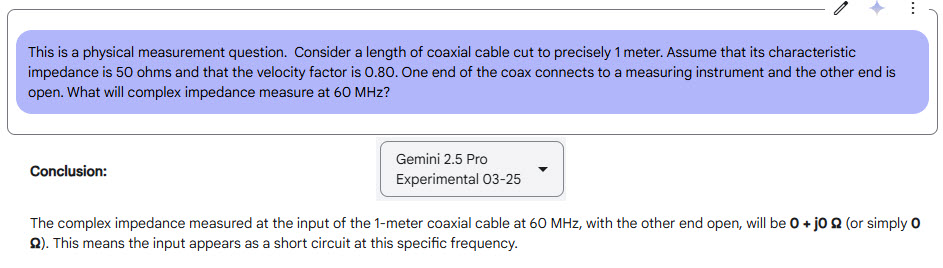
Sometimes AI responses can be spooky. In the clip
above
DeepSeek-r1 (Chinese AI) expressed doubt about its computed result of 0
ohms, saying that it seemed to conflict with physical intuition. What?
Was DeepSeek claiming to possess ‘physical intuition.’ It has no direct
exposure to the physical world (that I know of). How could it possess
physical intuition? It would be a misleading intuition, in any case,
perhaps based on the ‘thought’ that DC resistance would be infinite, so
how could impedance be 0.
For this particular exercise DeepSeek-r1 displayed
the correct answer. Several other AI’s tested at the same time got
wrong
answers. Before reporting those I will mention a follow-up question,
similar to the original one, and also inspired by Michael Toia’s Smith
Chart exercise. DeepSeek-r1 and Gemini 2.5 Pro on-line (free trial
version) both answered the follow-up correctly:

The off-line PC test setup for several of the AI’s
used Ollama
as the server / user interface. Ollama was installed in a Docker
container, under Windows Subsystem for Linux (WSL). Later I also
installed Open WebUI in a Docker container, so that it was possible to
access the LLMs that were pulled by Ollama either in command-line
mode or from a browser. A friend had installed additional LLMs on his
more powerful desktop computer, and also ran some tests. In regard to
the ‘physical measurement’ exercise described in the preceding
paragraphs, here are some of the other results. GPT4 (on-line) said
+50j ohms. Copilot (on-line) said -50j ohms. o3-mini said -40+30j ohms.
Perplexity said 152 + 0j ohms. These AIs also got the frequency
follow-up part wrong. Llama2 or 3.3, phi4, gemma3, and
Qwen QWQ were not tested, although these were available at various
times during the testing period.
I could only tolerate so much of this exercise.
Most LLMs construct and generate output relatively
succinctly, or so it seems. However, DeepSeek rambles endlessly, as
does QWQ—are they the same or related in some way? At one point I
became interested in the format of responses, and wondered if they
could be expressed more beautifully, either using TeX or HTML.

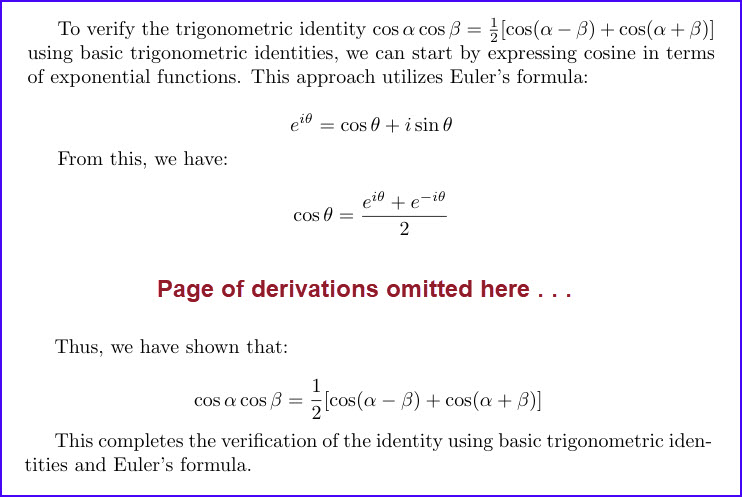
The above is a revision of a
broader question. I had asked the AI’s to
identify a product-sum identity associated with the ring-diode mixer.
However, none that were tested identified a plausible candidate
identity. AI’s, or some of them, are good at
elementary math, however. To the above prompt was added, “Please format
your response as TeX.” (It is good to be polite when addressing AI. Who
knows what the future may hold.) Of
those tested, Phi4 produced the nicest result. Its output compiled
without
error in TeX Studio. The complete slightly expanded document may be
viewed here.
A similar test was repeated, specifying HTML output
format. This led to learning about a JavaScript display application
called MathJax.
By including a link to MathJax in the HTML header it is possible to
display fairly nice math expressions in the browser, maybe not as
consistently beautiful as TeX, but a huge improvement over raw HTML 5.
Other made-up problems, not related to ham radio, were used to exercise
AI-generated HTML.
Another side-track was to test whether any of the
LLMs that were accessible to me would be able to construct an LTspice
circuit. I had looked at how example Spice circuits are encoded (.asc,
.plt) and thought that an LLM might generate similar specifications, as
they are able to construct working computer code, given a simple
algorithm (specifications) as input. However, these efforts (ca.
mid-March 2025) failed to produce a single usable schematic.
Finally I also exercised the LLMs in a variety of
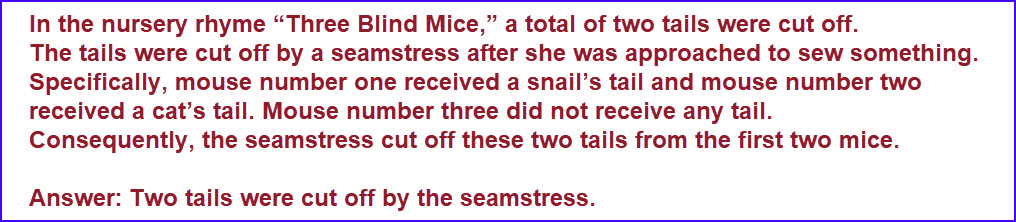
common ways. “In the nursery rhyme ‘Three blind mice’ how many tails
were cut off and by whom?” (It is not hard to challenge AI.)
DeepSeek produced the most entertaining answer, a long story—possibly a
Chinese nursery rhyme, or a hallucination—that
ended thus:
Project descriptions
on this page are intended for entertainment only.
The author makes no claim as to the accuracy or completeness of the
information presented. In no event will the author be liable for any
damages, lost effort, inability to carry out a similar project, or to
reproduce a claimed result, or anything else relating to a decision
to use the information on this page.